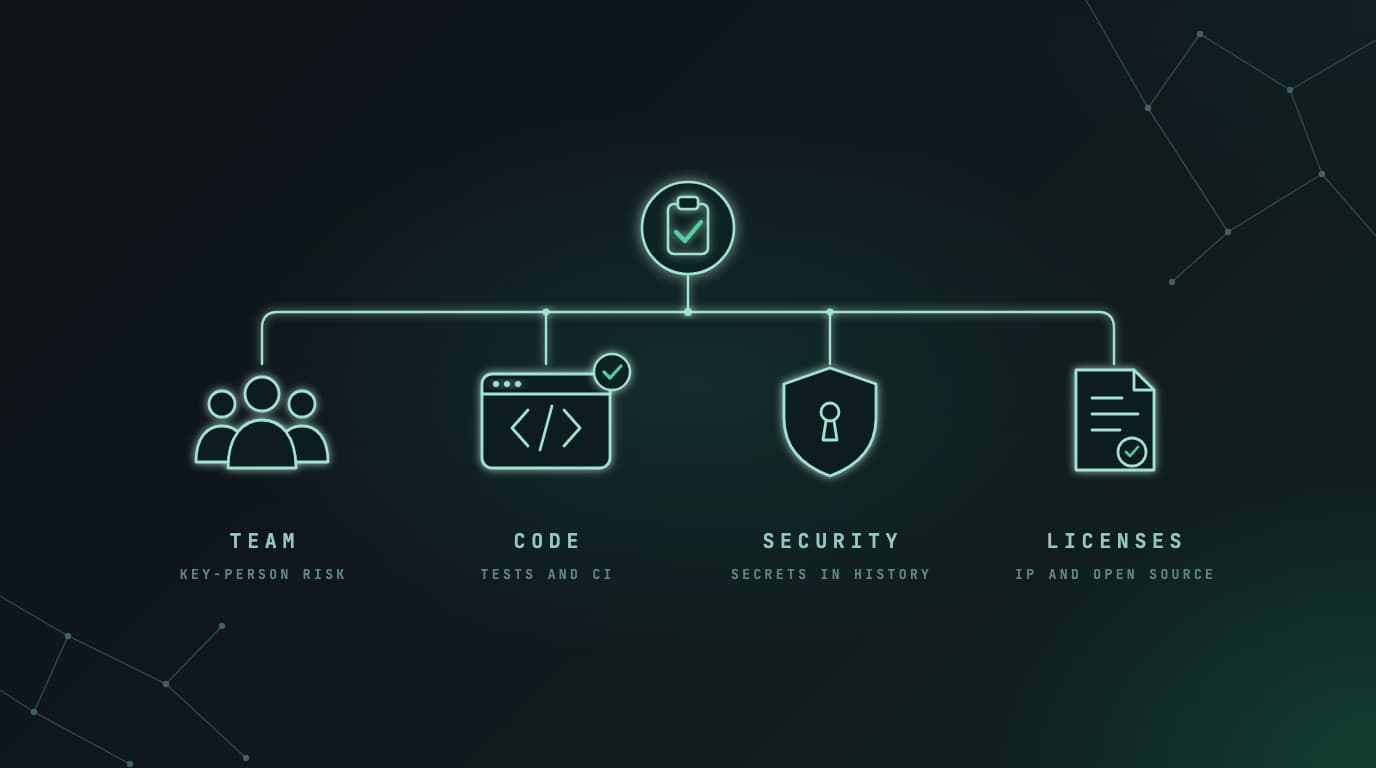
A technical due diligence checklist for a seed or Series A investment has to answer three questions. Can the technology carry the plan to the next round? What would it cost to fix what can't? And is there anything that could sink the company: customer data anyone can read, code the company doesn't own, or one person who holds the whole system in their head?
Search for a technical due diligence checklist and most of what you'll find is written for acquisitions: inventories of IT assets, contracts and data-room documents. A seed or Series A investment asks a narrower question. You're not buying the system. You're backing a small team to build what the deck promises, with your money.
This is the checklist I'd use, written for the investor rather than the engineer. I was CTO at Hexis, and I led Emblem's platform as CTO. Emblem is an AI due diligence platform for private equity. Its users need answers they can defend in an investment committee, so every number has to trace back to the page it came from. A technical review should meet the same bar: every finding points to evidence. Pulore offers technical due diligence for investors, and I do the reviews.
It starts with a one-page checklist and an example of what changes a deal, then explains the ten checks in plain terms. The commands are in an appendix for engineers, with what they printed on two small open-source repos of ours. Those repos show how each check works and how to read its output. They're not a startup's codebase, so they don't show what a startup's results look like.
The investor checklist on one page
Ask the company for:
- Read access to the real repositories, with their full history. A zip file or a screen share hides the history, and the history is where key-person risk shows.
- A read-only role in the cloud accounts, or at least the last three months of cloud bills and the list of people with admin access.
- Whatever docs exist: an architecture sketch, the list of third-party services, the incident log.
- Time with the CTO and with one engineer, separately. You'll ask them the same questions.
Founders are often wary of handing code to an investor who also backs their competitors. An independent reviewer under an NDA, who reports findings rather than code, usually settles it. That's how we work: we sign an NDA with the company before we get access, and you get the findings and the evidence behind them, not a copy of the code.
Check ten things:
| # | Check | What it answers | Red flag |
|---|---|---|---|
| 1 | Architecture | Can the design carry the plan in the deck? | A rewrite planned with the round's money |
| 2 | Who wrote the code | Who could leave and take the system with them? | One person wrote most of the last year's code, and nothing they know is written down |
| 3 | How recent the work is | Is the team shipping, and since when? | A history that starts with one commit that adds everything |
| 4 | Tests and CI | Can a new engineer change the code safely? | No tests on the paths that bring in revenue |
| 5 | Dependencies | How far behind is it, and what's known to be vulnerable? | No lockfile, or a framework past its end of life |
| 6 | Secrets | Are keys and passwords in the code or its history? | A live key in any commit, even a deleted one |
| 7 | Customer data | Who can reach it, and what stops everyone else? | Shared admin accounts, or no multi-factor sign-in |
| 8 | Infrastructure and cost | Are deploys, backups and alerts in hand? What drives the bill? | A backup nobody has restored |
| 9 | Licenses and IP | Does the company own its code, and can it sell it? | Contractors without IP assignments, or AGPL code in the product |
| 10 | AI claims | What's built in-house, and what does each user cost? | A "proprietary model" that's a prompt to someone else's API |
Ask the CTO, then ask an engineer the same questions:
- What breaks first with ten times the users?
- Who could leave and take what they know with them? What's written down?
- Can we have read access to the original repositories, with their full history?
- Which test would fail if checkout broke tomorrow?
- When did you last upgrade the main framework, and what's blocking the next upgrade?
- Has a key ever been committed? Was it rotated?
- Who can read customer data today, and how would you know if someone did?
- When did you last restore a backup, and how long did it take?
- Has everyone who wrote code, employees and contractors, signed an IP assignment with the company?
- What does each active user cost in model fees?
Where the two answers differ, look harder.
What changes the deal? A worked example
A finding changes the deal when it changes the decision, the price or the terms. Most findings don't. Two questions sort them: what would it cost to fix, against the size of the round, and could it sink the company?
Here they are, applied to real output from two small public repos of ours. pulore/supabase-gcp-pulumi, "the template" below, is a Pulumi program that runs Supabase Studio on Google Cloud. pulore/agents-md-study, "the study", holds the code and data behind our study of how 1,292 repos link CLAUDE.md and AGENTS.md. Both have one author, and both went public in November. Read as if they belonged to a startup:
- One person wrote every commit: five in the template, one in the study. That's the key-person question, and it could change the deal. It does if that person isn't a founder with vesting and nothing they know is written down, so ask before you decide.
- Each history starts with one commit that adds every file, on the day the repo went public. That doesn't change the deal by itself, but the code can't show who wrote what. Ask for the original repositories before you settle the key-person and IP questions.
- The tests and CI pass, and no published advisory matches the template's dependencies. That doesn't change the deal. Ask what the tests cover: the template's tests check the configuration it would deploy, not a deploy.
- No copyleft license among the template's 142 packages, and both copyright notices name the company. That doesn't change the deal either, but it doesn't prove ownership. That sits in contracts, which your lawyers check.
- No secret found in any commit. A scanner found none, and the four candidates a broader search turned up took minutes to clear.
So one result could change the deal, depending on who the author is, and one changes what you ask for. In a startup, what changes deals is in each check's red flags below, such as a live key in the history, contractors without IP assignments or a rewrite planned with the round's money. Each time, the question is what it costs to fix, against the size of the round.
The ten checks in plain terms
1. Architecture: does it fit the plan in the deck?
Why it matters at seed or Series A. The round pays for what the deck says comes next: more customers, a second product, an enterprise tier. The question is whether today's design can get there, or whether the money goes on rebuilding it.
How to check it. Ask the CTO to draw the system on one page: the apps, the services, the databases, the third-party APIs and where customer data sits. Then follow one core request through the code, such as a sign-up or the action customers pay for. Ask what breaks first with ten times the users, and check the answer against the data model.
At Hexis, where I was CTO, loading a few days of plans could take minutes as the company headed into its seed round. The cause was the data model. I rebuilt it, and those queries dropped to under 700ms, a key factor in closing the $2.1M seed round (the Hexis case study). A problem like that is cheaper to find before the money goes in than after.
Red flags:
- A rewrite planned with the round's money: months of work that customers never see.
- More moving parts than people, such as microservices, Kubernetes and three databases for a team of three.
- Less than the plan needs, such as a separate deployment per customer when the deck says a thousand customers.
- Nobody can draw it.
Ask the CTO:
- What breaks first with ten times the users, and what would you do about it?
- What would you build differently if you started today?
- Which third-party service would hurt most if it went down or doubled its price?
2. Who wrote the code, and who could leave
Why it matters. At seed, one founder often wrote most of the code. If they leave, the company loses the only map of the system. If an agency or freelancers wrote it, you need to know who holds the knowledge, and who owns the work (check 9).
How to check it. Count commits by author over the last year, then compare the names with the team in the deck. The count can't tell you who, or what, wrote the code. Git records whatever name the committer's machine is set to. A contractor working on a founder's account, or an AI coding agent working in an engineer's checkout, commits under that person's name. GitHub's Verified badge means the commit "is signed and the signature was successfully verified" (GitHub's docs, read November 12, 2026). That ties a commit to an account, not to a person. So in the interview, ask an engineer to walk you through a recent change.
Red flags:
- One person wrote most of the last year's commits, isn't a founder with vesting, and none of what they know is written down.
- Names in the history that aren't on the team and aren't under contract.
- Repos that sit in an agency's account or a founder's personal one, not the company's GitHub organization.
Ask the CTO:
- Who could leave and take what they know with them? What's written down?
- Who owns the GitHub organization, the cloud accounts and the domain?
- Which parts did contractors or an agency write, and under what contract?
3. How recent the work is
Why it matters. The deck shows a team that ships every week. The history shows whether it does, and since when.
How to check it. List the commits, count them by month, and check whether changes go through pull requests, where someone else reviews them before they merge. Gaps, a slowdown after someone left, or a burst just before the raise are all questions for the interview. Neither of our repos has a pull request, which is normal for one person. For a team of five, it would be a question.
Then look at where the history starts. Both of ours start on the day the repo went public, with a first commit that adds every file at once, so the history can't show how the code got there, or who wrote which part. A startup's repo can look the same after a move off an agency's GitHub, a squashed history or an export into a data room. None of that is wrong in itself. Ask for the original.
Red flags:
- A history that starts recently, with one commit that adds everything.
- Months without commits while the deck shows releases.
- Code that only exists as a zip file.
Ask the CTO:
- Can we have read access to the original repositories, with their full history?
- How often do you deploy to production? When was the last time?
4. Tests and CI: can a new engineer change it safely?
Why it matters. Most of a seed or Series A round goes on hiring. Tests decide how fast new engineers can change the code without breaking it. Full coverage isn't the bar at this stage. Tests on the paths that bring in revenue are: sign-up, payment and the thing customers pay for.
How to check it. Look for test files and a CI setup, and check that CI runs and passes. Then have an engineer run the tests from a clean copy, on a machine with no credentials on it, since running a company's tests runs its code. What the tests check matters more than how many there are.
On our repos. From a clean clone, the template's 62 tests passed in about 9 seconds, and CI passed on its last two pushes. The tests run against Pulumi's mocks, so they check the configuration the program would deploy, not a deploy. The repo's README records one end-to-end test deploy, on November 5. The study has no unit tests, but a script that recomputes every published number from the raw labels: 128 checks, 0 differences. A startup's version might be end-to-end checks or a job that reconciles payments. Ask whether it runs without someone remembering to run it.
Red flags:
- No tests on sign-up, payments or the core workflow.
- CI that's failing, switched off or skipping tests.
- Tests that only pass on one person's laptop.
Ask the CTO:
- Walk me through what happens between a merge and production.
- Which test would fail if checkout broke tomorrow?
- When did a bug last reach customers? How did you find out, and what changed after?
5. Dependencies: how far behind, and what's known to be vulnerable
Why it matters. Most of any app is other people's code. A framework that has fallen far behind means upgrade work that competes with features for the round's money. A known vulnerability in code that users reach can become a breach.
How to check it. Check there's a lockfile, so every install gets the same versions. Then list what's behind, and what's known to be vulnerable. Neither list is a to-do list. Reading them is the work.
A count of known vulnerabilities says little on its own. npm counts every package that depends on a vulnerable one, so one advisory deep in the tree can add many findings. Take each advisory, not the count, and ask three questions:
- Can an attacker reach it? What would they have to control, and does the vulnerable code run where users reach it?
- What can it touch? A build tool runs in CI, often next to deploy keys and other credentials, so "only a build tool" doesn't mean harmless.
- Is there a fix? A patch release, or the next major version?
A moderate advisory in a build tool, fixed by a patch release of one dependency, is often one line to change and a test run. Call it low once the answers show nobody can reach it and the CI that runs it holds nothing worth stealing. A high one in the web framework, fixed only in its next major version, can mean weeks of upgrade work.
On our repos. The template has a lockfile, no known vulnerabilities and five packages behind, none urgently (the appendix reads them one by one). No known vulnerabilities means only that no published advisory matches the versions it installs today. It says nothing about the template's own code, and a new advisory could change it tomorrow.
Red flags:
- No lockfile, so two installs a week apart can run different code.
- A framework or runtime past its end of life.
- High or critical advisories in code that users reach, with no plan to fix them.
- Copies of libraries pasted into the repo and changed.
Ask the CTO:
- When did you last upgrade the main framework? What's blocking the next upgrade?
- Who hears about a new vulnerability in a dependency, and how?
6. Secrets in the code and its history
Why it matters. A key committed once stays in the history after it's deleted from the code, and anyone with a copy of the repo has it. How a team handles secrets also tells you how it handles security in general.
How to check it. Run a maintained secret scanner over every commit on every branch, including what merge commits change, with its output redacted so the scan never prints a live key. Then list every file ever added with a name like .env or .pem. For this post we ran Gitleaks. By default it skips what merges change, and it follows ignore rules kept in the repo it scans, so the appendix shows the settings we used. TruffleHog classifies over 800 secret types and can check whether a key it finds still works (both read November 12, 2026). On a company's repo, agree with the company before you test its keys against anyone's API.
On our repos. Gitleaks found nothing in either repo. A broader search found four candidates in the template, and none is a secret. Reading them took a few minutes. That's the job: a tool finds candidates, and a person decides.
A clone isn't the whole story either. Rewriting history doesn't remove a secret from GitHub. Its docs say the old commits may still be reachable in clones and forks, by their SHA in cached views, and through pull requests, and that the first step for a leaked secret is to revoke or rotate it (GitHub docs, read November 12, 2026). So ask whether a key was ever committed, and whether it was rotated.
Red flags:
- A live key in any commit, even one that was later deleted.
.envfiles or production credentials in the repo.- The same database password in staging and production.
Ask the CTO:
- Where do passwords and API keys live, and who can read the production ones?
- Has a key ever been committed? Was it rotated?
- If a laptop were stolen tonight, what would you revoke?
7. Who can reach customer data
Why it matters. A breach at seed can end the company, and enterprise customers will ask about this before they sign. It's also the check a repo alone can't answer, and our two repos hold no customer data, so there's no output for it in the appendix.
How to check it. You need the cloud accounts and an admin's time. List everyone with production access: the cloud console, the database, the admin panel and the support tools. Check that GitHub, the cloud accounts, email and the domain registrar all require multi-factor sign-in. Read the rules that decide who can see which rows. In a Supabase app, those are row level security policies, and our security checklist for Lovable apps has the queries. Then test them on the running product, with the company's written permission: make two test accounts and try to read one's data as the other. Our reviews include that check. Then ask about the last incident.
Red flags:
- Shared admin accounts, or no multi-factor sign-in.
- A production database open to the internet, protected by a password alone.
- People who left the company who can still sign in.
- An app built with AI tools, with real users, whose database rules nobody on the team has read.
Ask the CTO:
- Who can read customer data today, and how would you know if someone did?
- When someone leaves, what gets revoked, and who checks?
- Has there been an incident? What changed after it?
8. Infrastructure, backups and the cloud bill
Why it matters. Manual deploys and untested backups work until the person who knows how leaves, or the database fails. The cloud bill grows with customers, and it's in the financial model you're relying on.
How to check it. Check whether the infrastructure is defined in code, with a tool such as Terraform or Pulumi, or was set up by hand in a console. Then ask for the last three months of cloud bills, and divide by active customers. Ask when a backup was last restored, and how long it took. For what a real drill looks like, our PostgreSQL 14 upgrade test restored 10 GB in a little over four minutes.
On our repos. The template is itself a Pulumi program, so its infrastructure is code. The study runs no infrastructure.
Red flags:
- A backup nobody has ever restored.
- One person who deploys by hand.
- A bill nobody can explain, or one growing faster than revenue.
- Production on a founder's personal account or card.
Ask the CTO:
- How does code get to production, and who can do it?
- When did you last restore a backup, and how long did it take?
- What drives the monthly cloud bill, and what does it look like with ten times the customers?
9. Licenses and IP: does the company own its code?
Why it matters. You're investing in something the company should own outright. Code written by contractors without an IP assignment, or open-source code under a license that limits how the product can be sold, becomes a problem at the next round or in an acquisition. This is where the technical review hands over to your lawyers: we flag, they decide.
How to check it. Check the repo's own license and copyright notice, then count the licenses its dependencies declare. Copyleft is what to look for. Section 13 of the AGPL asks anyone who modifies the software and lets users interact with it over a network to offer those users its source (AGPL-3.0, read November 12, 2026). For a SaaS product, that's worth a lawyer's look.
What none of this shows is who owns the code. Git shows who committed it, and the notice shows who claims it. Ownership sits in contracts: an IP assignment from every employee, contractor and agency that wrote code. That's for your lawyers, and it's worth checking against the names from check 2.
On our repos. The template's lockfile lists 142 packages, and none is under a copyleft license such as the GPL, AGPL, LGPL or MPL. Both repos are Apache-2.0, and both notices name the company.
Red flags:
- Contractors or an agency wrote code, and there's no IP assignment.
- An AGPL dependency in code that serves users.
- Code copied in from elsewhere without its license.
- A copyright notice that names an agency or a person, not the company.
Ask the CTO:
- Has everyone who wrote code, employees and contractors, signed an IP assignment with the company?
- Did any code come from a previous employer, or from an agency that kept rights to it?
- Who checks the license when you add a dependency?
10. AI claims
Why it matters. If the deck says AI, two numbers matter: how much of it is the company's own work, and what each user costs in model fees. A thin layer over someone else's model can be a fine business, but you should know which one you're buying.
How to check it. Find every call to a model provider. A search for their SDKs and endpoints is a start. Then ask for the model providers' bills and divide by active users. And ask for the evaluation set, the examples they test the model's answers against, with the latest results.
On our repos. The search found nothing in either repo. That's right for the template, which has no AI in it. The study is the instructive one. Its README says a Claude Code agent read and labelled the diffs, yet the search finds no code that calls a model. That step ran in an agent session, and a script recorded its labels. A startup's version is a feature the deck calls AI that turns out to be a person, or an agent someone runs by hand. That can be fine, if the deck says so.
Red flags:
- A "proprietary model" that's a prompt to someone else's API.
- No evaluation set, so nobody knows whether a model change made the answers worse.
- Model fees per user close to the price per user, or above it.
- Customer data sent to a model provider without terms that allow it.
Ask the CTO:
- Which parts call someone else's model, and which are yours?
- What does each active user cost in model fees?
- How do you know when a model change makes the answers worse?
Technical due diligence questions to ask the CTO
If you have half an hour with the CTO, start with these ten, one from each check. The rest are under each check above.
- Architecture: What breaks first with ten times the users, and what would you do about it?
- Who wrote the code: Who could leave and take what they know with them? What's written down?
- How recent the work is: Can we have read access to the original repositories, with their full history?
- Tests and CI: Which test would fail if checkout broke tomorrow?
- Dependencies: When did you last upgrade the main framework? What's blocking the next upgrade?
- Secrets: If a laptop were stolen tonight, what would you revoke?
- Customer data: Who can read customer data today, and how would you know if someone did?
- Infrastructure and backups: When did you last restore a backup, and how long did it take?
- Licenses and IP: Has everyone who wrote code, employees and contractors, signed an IP assignment with the company?
- AI claims: Which parts call someone else's model, and which are yours?
Running the interviews
Our review interviews the CTO and one engineer. Whoever runs yours, a few habits help:
- Ask about the last time, not the usual way. "When did a bug last reach customers?" gets a story. "How do you handle bugs?" gets a policy.
- Ask the engineer the same questions. Where the two answers differ, look harder.
- Ask to be shown. The CI page, the list of admins, the last backup restore. A screen share takes a minute.
- Check the answers against the code, and ask for evidence where they don't match. If the CTO says every change is reviewed and the repo has no pull requests, the review may happen somewhere else: in another tool, in pairing, or before a push. Ask to see a recent change and its review. If nobody can show you one, that's the finding.
Where this fits in VC due diligence
Technical due diligence is one workstream. A venture capital due diligence checklist also covers the market and customers, the team and their references, the financials, and the legal side: the cap table, the contracts and the IP assignments. The technical review feeds the others. The cloud bill and the hiring plan go into the financial model, and the license and IP flags go to the lawyers. What it adds is an independent answer to one question: can this team build and run what the plan needs, and at what cost?
How to read the report
A good report takes five minutes to read and holds up for an hour of questions. Read it in this order:
- The verdict. Invest, invest with conditions, or pass, with the reasons, written for the deal team rather than for engineers.
- The high findings. Each finding is rated high, medium or low, with what it means for the deal. High could change the decision or the price. Medium needs fixing but doesn't change the decision on its own. Low is worth knowing and small to fix.
- The cost against the round. Each finding carries the effort and cost to fix it. Three engineer-months of fixes mean one thing in a $2M seed round and another in a $15M Series A.
- The conditions. High findings are where conditions come from: rotate the leaked key before close, get IP assignments from every contractor, restore a backup within 60 days. The report lists the questions to put to the founders and the conditions we'd attach.
- The evidence. Every finding should point to something you could check yourself: a file and line, a command and its output, a setting. If one doesn't, ask for it.
For how we write up a finding and its evidence, see the sample report from our code audit. It's an audit of a demo app we built for the purpose, not a client's. A due diligence report rates findings for the deal team rather than ranking fixes for engineers, but each finding traces to evidence the same way.
A technical due diligence report isn't a full penetration test, a SOC 2 audit, financial due diligence or a legal opinion on IP. It should say what it checked and what it didn't.
What technical due diligence costs, and how long it takes
At Pulore, technical due diligence on a seed to Series A company with one product and up to ten engineers is a fixed price from $7,500, agreed in writing before we start. We sign an NDA with the company, review the code, the architecture, the cloud setup and security, run non-destructive security checks against the running product with the company's written permission, and interview the CTO and one engineer. Every finding points to its evidence: a file and line, a command and its output, or a setting. You get the report in 7 to 10 business days, which start once the company gives us read-only access to its code, cloud accounts and docs, and then a call to walk the deal team through it.
Buying a small software business, in a deal under $1M, starts at $5,000 and takes 7 to 10 business days. Later-stage companies, several products or a larger acquisition start at $15,000, over two to three weeks. A full penetration test is an add-on, quoted separately. Financial due diligence and SOC 2 audits aren't included.
We take no paid work from the company we review for six months, unless you agree to it. Pulore also builds software, and the rule keeps the findings separate from any sale.
If you're a founder preparing for an investor's review, our code audit finds the problems first, in two weeks, from $5,000, so you can fix the cheap ones and explain the rest.
Engineer's appendix: the commands and what they printed
This part is for whoever runs the checks. We ran every code check above on November 12, 2026, at 07:55 UTC, from fresh clones of pulore/supabase-gcp-pulumi at commit 82fbc60 (40 files, 3,255 lines of TypeScript and shell) and pulore/agents-md-study at 23dcdbe (46 files, 2,661 lines of Python, JavaScript and shell). The tools were git 2.56.0, GitHub CLI 2.102.0, Node.js 26.12.1 with npm 11.20.0, Python 3.12.2, jq 1.7 and Docker 29.9.2, on macOS, with Gitleaks 8.30.1 from ghcr.io/gitleaks/gitleaks:v8.30.1. Nothing was installed globally: each repo's dependencies went into its own clone. Paths are shortened in the commands below, and long output is trimmed where it says ....
Before you run anything on a company's code
Installing, building or testing a repo runs its code. Do it for a company's repo in a throwaway container or virtual machine with no personal or production credentials: no cloud logins, SSH keys or tokens. npm ci --ignore-scripts skips packages' install scripts, but it doesn't make the next steps safe. npm's docs say npm test and npm run "will still run their intended script" with that setting (npm docs, read November 12, 2026), and a test script can read whatever your account can.
Both repos below are our own code, so we ran them directly on a Mac. Gitleaks only reads the history, and we still ran it with no network and the repo mounted read-only.
Check 2: who wrote the code
$ git -C supabase-gcp-pulumi shortlog -sn --no-merges --since='12 months ago' HEAD
     5	Sachin Mour

$ git -C agents-md-study shortlog -sn --no-merges --since='12 months ago' HEAD
     1	Sachin Mour

$ gh api repos/pulore/supabase-gcp-pulumi/commits --jq '.[] | "\(.sha[0:7]) \(.author.login) verified=\(.commit.verification.verified)"'
82fbc60 sachinmour verified=true
69b28db sachinmour verified=true
367a784 sachinmour verified=true
d7b1d3e sachinmour verified=true
6a69ad9 sachinmour verified=true
Every commit is under my name and signed with a key on my GitHub account. If you script this check, name a revision such as HEAD. Without one, git shortlog reads from standard input when it isn't a terminal, and prints nothing. Our first run did exactly that.
Check 3: how recent the work is
$ git -C supabase-gcp-pulumi log --format='%h %ad %s' --date=short
82fbc60 2026-11-12 Update @pulumi/pulumi to 3.274.1
69b28db 2026-11-05 Add the 5 November 2026 test deploy to the README
367a784 2026-11-05 Require TLS between postgres-meta and Cloud SQL
d7b1d3e 2026-11-05 Use a separate, slower health check for auto-healing
6a69ad9 2026-11-02 Supabase Studio on Google Cloud with Pulumi

$ git -C supabase-gcp-pulumi log --since='12 months ago' --format=%ad --date=format:%Y-%m | sort | uniq -c
   5 2026-11

$ git -C supabase-gcp-pulumi show --stat --format='%h %ad %s' --date=short $(git -C supabase-gcp-pulumi rev-list --max-parents=0 HEAD) | tail -1
 40 files changed, 6967 insertions(+)

$ gh pr list --repo pulore/supabase-gcp-pulumi --state all --limit 100 --json number --jq length
0
Check 4: tests and CI
$ gh run list --repo pulore/supabase-gcp-pulumi --limit 2
completed	success	Update @pulumi/pulumi to 3.274.1	CI	main	push	43163983359	19s	2026-11-12T05:49:58Z
completed	success	Add the 5 November 2026 test deploy to the README	CI	main	push	42043954606	33s	2026-11-05T14:19:52Z

$ /usr/bin/time -p bash -o pipefail -c 'git clone --quiet https://github.com/pulore/supabase-gcp-pulumi.git && cd supabase-gcp-pulumi && npm ci --ignore-scripts --no-audit --no-fund && npm run build --silent && npm test 2>&1 | tee ../test.log | grep -E "^ℹ (tests|pass|fail)|✖"' 2>&1; echo "exit $?"
npm warn deprecated @opentelemetry/sdk-trace-node@2.12.0: Use @opentelemetry/sdk-trace package
npm warn deprecated @opentelemetry/sdk-trace-base@2.12.0: Use @opentelemetry/sdk-trace package

added 142 packages in 2s
ℹ tests 62
ℹ pass 62
ℹ fail 0
real 9.22
user 7.44
sys 4.47
exit 0
-o pipefail makes a failing test fail the whole command. Without it, the exit status is grep's, which succeeds whenever it prints the summary. Install and build errors print as they happen, ✖ lines name failing tests, and the full output stays in test.log. A stand-in project with one failing test and one passing shows the difference:
$ bash -c 'cd failing-stand-in && npm test 2>&1 | grep -E "^ℹ (tests|pass|fail)"'; echo "exit $?"
ℹ tests 2
ℹ pass 1
ℹ fail 1
exit 0

$ bash -o pipefail -c 'cd failing-stand-in && npm test 2>&1 | tee ../stand-in-test.log | grep -E "^ℹ (tests|pass|fail)|✖"'; echo "exit $?"
✖ adds up (0.631708ms)
ℹ tests 2
ℹ pass 1
ℹ fail 1
✖ failing tests:
✖ adds up (0.631708ms)
exit 1
The study's script that recomputes its published numbers:
$ python3 -I scripts/verify_from_labels.py labels aggregates > ../verify.log 2>&1; echo "exit $?"; grep -c "^OK " ../verify.log; tail -1 ../verify.log
exit 0
128
0 difference(s)
Check 5: dependencies
$ npm outdated
Package         Current   Wanted  Latest  Location                     Depended by
@pulumi/gcp      10.2.0   10.2.0  10.3.0  node_modules/@pulumi/gcp     supabase-gcp-pulumi
@pulumi/random   4.21.4   4.21.4  4.21.6  node_modules/@pulumi/random  supabase-gcp-pulumi
@pulumi/tls       5.6.2    5.6.2   5.6.3  node_modules/@pulumi/tls     supabase-gcp-pulumi
@types/node     22.20.5  22.20.5  26.6.6  node_modules/@types/node     supabase-gcp-pulumi
typescript        5.9.3    5.9.3   7.0.2  node_modules/typescript      supabase-gcp-pulumi

$ npm audit --json > ../audit.json; jq .metadata.vulnerabilities ../audit.json
{
  "info": 0,
  "low": 0,
  "moderate": 0,
  "high": 0,
  "critical": 0,
  "total": 0
}
The clean install in check 4 is a check in itself: npm ci exits with an error if the lockfile and package.json disagree (npm docs, read November 12, 2026). In npm outdated, the three Pulumi packages are a minor or patch release behind, routine to take with a test run. @types/node 26 is newer than the Node.js 22 the template targets, and Node.js 22 is supported until April 30, 2027 (Node.js release schedule, read November 12, 2026), so staying on 22's types is right. TypeScript is two majors behind, but it's a build tool with no known advisory: worth planning, not urgent. The study's one npm package, marked, is pinned, has no known advisories and is a minor version behind (18.1.1, with 18.2.0 out).
When the audit's count isn't zero, two commands turn it into something you can read:
# The advisories behind the count, with their severity
jq -r '[.vulnerabilities[] | .via[] | select(type=="object") | "\(.name) \(.severity) \(.url)"] | unique | .[]' ../audit.json

# Which of the company's own dependencies brings in a package
npm ls <package>
For each advisory, fixAvailable in npm's JSON report says whether a fix exists and, usually, whether it takes a major upgrade. npm ls also explains the two warnings from the timed install: both deprecated packages come in through Pulumi's SDK, which was at its latest release when we ran this, and the lockfile pins version 2.12.0 of each. When we checked again on November 16, version 2.12.1 of both wasn't marked deprecated. Refreshing the two lockfile entries with npm update @opentelemetry/sdk-trace-node @opentelemetry/sdk-trace-base cleared both warnings, and the build and all 62 tests still passed: a routine fix, not a risk.
$ npm ls @opentelemetry/sdk-trace-node @opentelemetry/sdk-trace-base | tail -n +2
`-- @pulumi/pulumi@3.274.1
  +-- @opentelemetry/sdk-trace-base@2.12.0
  `-- @opentelemetry/sdk-trace-node@2.12.0
    `-- @opentelemetry/sdk-trace-base@2.12.0 deduped

$ npm view @pulumi/pulumi dist-tags.latest
3.274.1
The study's Python uses only the standard library. A short script that compares every import with Python's own list of standard modules found nothing else:
$ python3 -I stdlib_check.py scripts
20 files, 24 imported modules, own modules: 2
not in the standard library or the repo: none
Check 6: secrets
Gitleaks 8.30.1, the latest release, from its official image, with no network, the repo mounted read-only and findings redacted:
$ docker run --rm --network none -v "$PWD/supabase-gcp-pulumi:/repo:ro" ghcr.io/gitleaks/gitleaks:v8.30.1 git /repo --log-opts="--all --diff-merges=first-parent" --ignore-gitleaks-allow --redact --verbose --no-color --no-banner
7:56AM INF 5 commits scanned.
7:56AM INF scanned ~292790 bytes (292.79 KB) in 42.8ms
7:56AM INF no leaks found

$ docker run --rm --network none -v "$PWD/agents-md-study:/repo:ro" ghcr.io/gitleaks/gitleaks:v8.30.1 git /repo --log-opts="--all --diff-merges=first-parent" --ignore-gitleaks-allow --redact --verbose --no-color --no-banner
7:56AM INF 1 commits scanned.
7:56AM INF scanned ~2589932 bytes (2.59 MB) in 434ms
7:56AM INF no leaks found
Three settings matter on a company's repo:
--log-opts="--all --diff-merges=first-parent". Git's docs say that unless a--diff-mergesoption is given, "merge commits will not show a diff" (git log, read November 12, 2026). Gitleaks 8.30.1 runsgit log -pwithout one by default (its source, read November 12, 2026), so it skips anything a merge adds itself, such as a key typed in while resolving a conflict.first-parentshows each merge's full diff against its first parent.--log-optsreplaces Gitleaks's defaults, so keep--allin it.--ignore-gitleaks-allow. Without it, Gitleaks skips lines markedgitleaks:allow.- The repo's own rules. Gitleaks follows a
.gitleaks.tomlor.gitleaksignorein the repo it scans. Neither of ours has one. In a company's repo, read them first: they decide what the scan leaves out.
A scanner sees only what its rules describe, and Gitleaks 8.30.1 has 222. For comparison, we also ran a broader grep with ten patterns of our own, for AWS and Google API keys, GitHub and Slack tokens, live Stripe keys, keys that start with sk-, private keys, JSON Web Tokens, and passwords or keys assigned in code:
AKIA[0-9A-Z]{16}
AIza[0-9A-Za-z_-]{35}
gh[pousr]_[A-Za-z0-9]{36}
github_pat_[A-Za-z0-9_]{22,}
xox[abprs]-[A-Za-z0-9-]{10,}
sk_live_[0-9A-Za-z]{24,}
sk-[A-Za-z0-9_-]{20,}
-----BEGIN [A-Z ]*PRIVATE KEY-----
eyJ[A-Za-z0-9_-]{10,}\.[A-Za-z0-9_-]{10,}\.[A-Za-z0-9_-]{10,}
(password|passwd|secret|api[_-]?key|token)["']?[[:space:]]*[:=][[:space:]]*["'][^"'[:space:]]{8,}["']
The grep finds the commits whose changes, merges included, add or remove a matching line, then prints where each match sits: commit, file and line, never the text. The second command lists every file ever added with a name like .env or .pem.
$ re=$(paste -sd'|' secrets-patterns.txt)

$ git -C supabase-gcp-pulumi log --all --diff-merges=first-parent -s -G"$re" --format=%h | xargs -I{} git -C supabase-gcp-pulumi grep -nIE -e "$re" {} | cut -d: -f1-3
6a69ad9:test/helpers/mocks.ts:36
6a69ad9:test/helpers/mocks.ts:148

$ git -C supabase-gcp-pulumi log --all --diff-merges=first-parent --diff-filter=A --name-only --format= | grep -iE '(^|/)\.env|\.pem$|\.key$|\.p12$|\.pfx$|id_rsa|credential|secret'
components/secret.ts
test/fixtures/outline-test-cert.pem
Four candidates, and none is a secret. Line 36 of test/helpers/mocks.ts is a placeholder key, MOCKSECRETPRIVATEKEY, which one of the template's tests uses to make sure no secret value reaches the virtual machines' metadata. Gitleaks passed over it because its private-key rule wants at least 64 characters between the markers (its rules, read November 12, 2026), and the grep matched the first marker alone. Line 148 is the name of a Google Cloud resource type. components/secret.ts is the code that stores secrets in Google's Secret Manager. The .pem file is a test certificate for 203.0.113.10, an address reserved for documentation (RFC 5737, read November 12, 2026), with no private key in it. The study had no candidates.
Our repos have no merge commits, so the merge option changes nothing there. To see what it changes, we made a throwaway repo where two branches edit the same line, and the commit that resolves the conflict adds a made-up GitHub token:
$ git -C merge-test log --all -p --no-color | grep -cE -f secrets-patterns.txt
0

$ git -C merge-test log --all -p --diff-merges=first-parent --no-color | grep -cE -f secrets-patterns.txt
1

$ docker run --rm --network none -v "$PWD/merge-test:/repo:ro" ghcr.io/gitleaks/gitleaks:v8.30.1 git /repo --redact --no-color --no-banner
7:56AM INF 3 commits scanned.
7:56AM INF scanned ~105 bytes (105 bytes) in 26.1ms
7:56AM INF no leaks found

$ docker run --rm --network none -v "$PWD/merge-test:/repo:ro" ghcr.io/gitleaks/gitleaks:v8.30.1 git /repo --log-opts="--all --diff-merges=first-parent" --ignore-gitleaks-allow --redact --verbose --no-color --no-banner
Finding:     REDACTED
Secret:      REDACTED
RuleID:      github-pat
...
File:        config.txt
Line:        2
Commit:      f1a1574e337ef972c7ddbdac2c1a60b9d9ff68d1
...
7:56AM INF 4 commits scanned.
...
7:56AM WRN leaks found: 1
With its defaults, Gitleaks scanned three of the four commits and missed the token. With the merge option, it found it, and printed where it is, not what it is. Our grep printed f1a1574:config.txt:2 for it, and the file check found .env.production, added in the same merge, only with the merge option.
Check 8: infrastructure
$ git -C supabase-gcp-pulumi ls-files | grep -E '\.tf$|Pulumi\.yaml|cdk\.json|serverless\.yml|docker-compose|Dockerfile|helm|k8s'
Pulumi.yaml
Check 9: licenses
npm's lockfile records each package's declared license, so jq can count them without installing anything:
$ gh api repos/pulore/supabase-gcp-pulumi/license --jq .license.spdx_id
Apache-2.0

$ cat supabase-gcp-pulumi/NOTICE
supabase-gcp-pulumi
Copyright 2026 Pulore Software Consultancy FZCO

$ jq -r '.packages | to_entries[] | select(.key != "") | .value.license // "NONE"' supabase-gcp-pulumi/package-lock.json | sort | uniq -c | sort -rn
  70 MIT
  42 Apache-2.0
  12 ISC
  12 BSD-3-Clause
   1 SEE LICENSE IN LICENSE
   1 Python-2.0
   1 CC0-1.0
   1 CC-BY-3.0
   1 BSD-2-Clause
   1 (BSD-3-Clause AND Apache-2.0)
One package says only "SEE LICENSE IN LICENSE". That's @logdna/tail-file 2.2.0, and its LICENSE file is MIT. The study's one npm package, marked, is MIT too.
Check 10: calls to AI models
$ git -C agents-md-study grep -nIiE 'api\.openai\.com|api\.anthropic\.com|generativelanguage\.googleapis|bedrock-runtime|aiplatform\.googleapis|from openai|import openai|@anthropic-ai/sdk|from anthropic|import anthropic|@google/genai|google\.generativeai|langchain|llamaindex' -- . ':!package-lock.json' ':!scripts/package-lock.json'
(exit 1)
Exit status 1 means no matches. The same search on the template found none either.
What the run covers, and what it doesn't
It covers the code checks in sections 2 to 6 and 8 to 10, with GitHub's data read through the GitHub CLI. It doesn't cover whether the tests test the right things, flaws in the dependencies that no advisory has reported yet, secrets in formats no rule or pattern describes, or anything about people, contracts or production. Sections 1 and 7 need a product's owners and its cloud accounts, which two open-source repos don't have.
Frequently asked questions
What should a technical due diligence checklist cover for a seed or Series A startup?
Ten things: whether the architecture fits the plan in the deck; who wrote the code and who could leave; how recent the work is; tests and CI; how far behind the dependencies are; secrets in the code's history; who can reach customer data; deploys, backups and the cloud bill; open-source licenses and IP ownership; and any AI claims. Answer what you can from the code and the cloud account first, then test the answers in interviews with the CTO and an engineer.
What questions should investors ask a startup's CTO?
Ask about the last time something happened, not how it usually works. Who could leave and take what they know with them? What happens between a merge and production? Which test would fail if checkout broke? Who can read customer data today? When did you last restore a backup, and how long did it take? Has everyone who wrote code signed an IP assignment? What does each user cost in model fees? Then ask an engineer the same questions and compare the answers.
What are the red flags in technical due diligence?
One person who wrote most of the last year's code and could leave. A history that starts recently with one commit that adds everything. No tests on the paths that bring in revenue. A framework past its end of life. A live key anywhere in the git history. Shared admin accounts or no multi-factor sign-in. A backup nobody has restored. A cloud bill nobody can explain. Code the company can't show it owns. And a rewrite planned with the round's money.
How long does technical due diligence take, and what does it cost?
At Pulore, a review of a seed to Series A company with one product and up to ten engineers is a fixed price from $7,500. You get the report in 7 to 10 business days, which start once the company gives read-only access to its code, cloud accounts and docs. Buying a small software business, in a deal under $1M, starts at $5,000 and takes 7 to 10 business days. Later-stage companies, several products or a larger acquisition start at $15,000, over two to three weeks.
Can I do technical due diligence myself?
Part of it. With read access to the repos, the code checks in this post take minutes to run, and the commands are in its engineer's appendix. Run them in a throwaway container or virtual machine with no personal or production credentials, because installing, building and testing a repo runs its code. Reading what they print is the work: whether a list of reported vulnerabilities is one version bump or months of upgrades, whether the architecture will carry the plan, and whether the interview answers match the code. For that, bring in someone who has run production systems.
Is technical due diligence a penetration test or a security audit?
Not a full one. It reviews security as part of the code and the architecture: secrets, who can reach customer data, sign-in and permissions, and what happened after past incidents. Ours also runs non-destructive checks against the running product, with the company's written permission, such as whether one test account can read another's data. A full penetration test, where testers attack the running system in depth, is an add-on we quote separately. It isn't a compliance audit such as SOC 2, which only a licensed auditor can issue, or a legal review of IP: we flag what your lawyers should check.
What's in a technical due diligence report?
Ours has a verdict (invest, invest with conditions, or pass, with the reasons), each finding rated high, medium or low with what it means for the deal, the effort and cost to fix each one, the questions to put to the founders and the conditions we'd attach, and a technical appendix with the evidence. A call to walk the deal team through it comes with it.