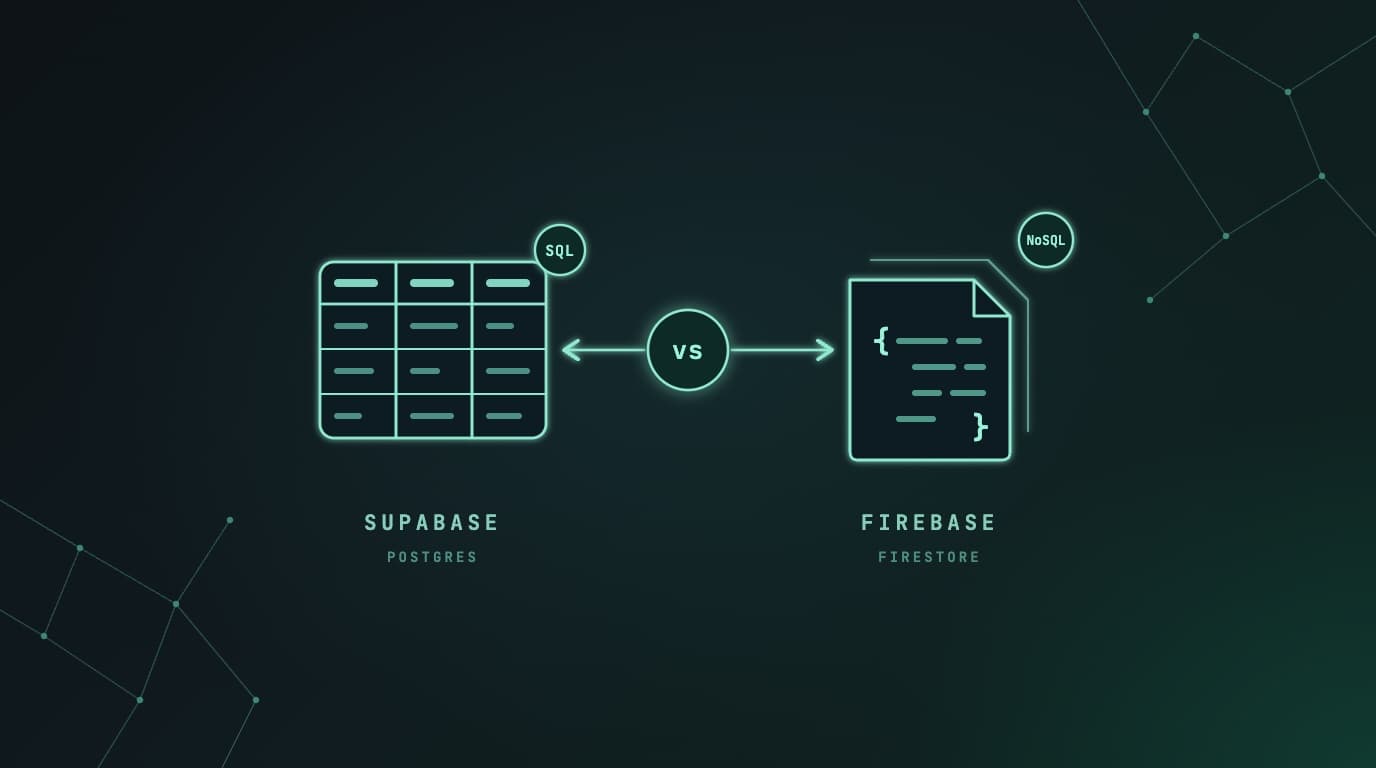
Supabase is a Postgres database with auth, file storage, edge functions and realtime built around it. It's open source, and you can run it yourself. Firebase is Google's app backend built around Firestore, a document database whose mobile SDKs work offline and sync, and it runs only on Google's cloud. If your data is relational, or you may one day need to run the backend outside Google Cloud, operate it yourself or move the database to another host, pick Supabase. If you're building a mobile app that has to work offline, and you'd rather pay per operation starting from zero, Firebase is built for that.
We've run self-hosted Supabase on Google Cloud for Hexis and set it up for clients, so we know the Supabase side from production. Every price and limit below comes from Supabase's and Firebase's own pricing pages and docs, checked on November 18, 2026, in US dollars, before tax. Firestore prices depend on where the database lives, so both Iowa (us-central1) and the United States multi-region (nam5) are shown.
The short version
| Supabase | Firebase | |
|---|---|---|
| Database | Postgres: tables, joins, foreign keys and SQL | Firestore: documents in collections. Postgres is a separate product, SQL Connect |
| Access rules | Row level security policies, written in SQL. Queries get only the rows they allow | Security Rules, in their own language. A query that could return a forbidden document fails |
| Sign-in | 50,000 MAU on Free and 100,000 on Pro, then $0.00325 each. TOTP MFA included | Email, social and anonymous sign-in at no cost. MFA needs Identity Platform, which bills each MAU over 50,000 |
| SAML sign-in | 50 users on Pro and Team, then $0.015 each | Needs Identity Platform: 50 users, then $0.015 each |
| Server code | Edge Functions, plus Postgres functions, triggers and cron | Cloud Functions, on the Blaze plan only |
| Realtime | Postgres Changes, Broadcast and Presence | Firestore listeners, and the Realtime Database |
| Free plan | 500 MB database, two projects, paused after 7 days without activity | Spark: 1 GiB in Firestore, 50,000 reads and 20,000 writes a day. No Cloud Functions or Cloud Storage |
| Paid plan | Pro, from $25 a month per organization, with $10 of compute credit | Blaze, pay as you go, with Spark's free quotas included |
| Spending limit | A spend cap, on by default on Pro | Budget alerts. Spend caps, in Preview, cover only a few products |
| Self-hosting | Yes, with Docker | No |
| Exporting data | pg_dump, or supabase db dump --remote | A managed export to Cloud Storage |
The data model: Postgres vs Firestore
Every Supabase project is a full Postgres database (database docs). You get tables, foreign keys, joins, transactions, views and more than 50 preconfigured extensions. Supabase generates a REST API from your schema with PostgREST, offers GraphQL through pg_graphql, and pools connections with Supavisor. If you can model it in SQL, you can store it and report on it.
Firestore stores documents in collections, and a document can hold subcollections, nested up to 100 levels deep (data model). A document can be up to 1 MiB. Queries support OR conditions up to 30 disjunctions, count, sum and average aggregations, and vector search (queries). Relational-style joins are documented only for the Enterprise edition, through pipeline operations, which became generally available in April 2026 (joins). On the Standard edition, data you read together has to sit in the same document or come from a second query.
Where Firestore shines is the client. Its mobile SDKs cache data, keep working offline and sync when the connection comes back. Offline persistence is on by default on Android and Apple platforms, and off by default on the web (offline data).
Firebase has Postgres too. SQL Connect, called Data Connect until April 2026, is a managed PostgreSQL database on Cloud SQL, with a GraphQL schema and generated SDKs, generally available since April 2025 (SQL Connect). On Blaze, the first 250,000 operations a month are free, then $0.90 per million, plus the Cloud SQL instance, from $9.37 a month (SQL Connect pricing). It sits beside Firestore rather than replacing it.
Firestore also has an Enterprise edition, with a MongoDB-compatible mode since August 2025, billed in read and write units instead of documents (editions). The prices in this post are for the Standard edition.
Security: row level security vs Security Rules
Both let client apps read and write the database directly, so both rely on rules checked on every request.
Supabase uses Postgres row level security (RLS docs). A request runs as the anon role when the user is signed out and as authenticated when signed in, and a policy can compare a column with auth.uid(), the signed-in user's ID. Tables created in the dashboard's Table Editor have RLS turned on (tables guide). Tables created with SQL need it turned on by hand, and the Security Advisor flags public tables without it (advisors). They also need grants once Supabase's change to its defaults reaches a project. Its changelog set October 30, 2026 as the date for existing projects, after new projects began getting it on May 30: new tables in public no longer get grants for anon, authenticated and service_role automatically, so the REST and GraphQL APIs can't reach them until a grant allows it, whatever their policies say. Tables that already existed keep their grants. The publishable key is meant for client code. The secret key maps to the service_role role, which has Postgres's BYPASSRLS attribute, so no policy applies to it (API keys). Our Lovable security checklist has the SQL to find missing and over-permissive policies.
Firebase uses Security Rules, written in a language based on Google's Common Expression Language (rules language). match blocks select document paths, allow statements set the conditions for each operation, and request.auth holds the signed-in user. A rule can read other documents with get() or exists(), up to 10 calls for a single-document request or a query and 20 for transactions and batched writes, and those reads are billed (limits). Firestore's server client libraries and the Admin SDK skip the rules entirely and authenticate with IAM instead (get started). App Check adds a second gate: with enforcement on, requests from apps that can't attest that they're yours are rejected (App Check).
The difference in practice: an RLS policy is SQL, so it can check a memberships table or any other table. A Security Rule matches a path and can look up a limited number of documents. Both fail the same way, with a rule that says yes to everyone.
Security Rules are not filters
The bigger difference is what a rule does to a query that lists documents. An RLS policy works like a WHERE clause added to every query (RLS docs, read November 18, 2026). Rows it doesn't allow are left out, and the query succeeds. Firestore checks a query against every document it could return, not the ones it does return. If any of them could break a rule, the whole query fails. Firebase's docs say rules "are not filters" (rules and queries, read November 18, 2026).
Take invoices that only their owner may read. In Firestore:
rules_version = '2';
service cloud.firestore {
  match /databases/{database}/documents {
    match /invoices/{invoiceId} {
      allow read: if request.auth != null && request.auth.uid == resource.data.ownerId;
    }
  }
}
// Fails, even if every invoice in the collection belongs to this user
await getDocs(collection(db, "invoices"));
// Works: the query carries the same condition as the rule
await getDocs(query(collection(db, "invoices"), where("ownerId", "==", uid)));The same rule in Supabase, as a policy. A policy does nothing until RLS is on for the table, and on projects where new tables no longer get API grants, the authenticated role needs one:
alter table invoices enable row level security;

create policy "Owners read their invoices"
on invoices for select to authenticated
using ((select auth.uid()) = owner_id);

grant select on invoices to authenticated;
// Works, and returns only this user's invoices
await supabase.from("invoices").select();We ran the Firestore rules and queries in Firebase's emulator, and the policy in Supabase's Postgres 17 image, on November 12, 2026. With the policy created but RLS still off, a signed-in user's select returned every owner's invoices.
So on Firestore, every query has to carry the conditions its rules check, and tightening a rule can make an existing query fail outright. On Postgres, the same change returns fewer rows. Supabase's performance guide still says to add the filter, .eq("owner_id", userId), and to use RLS for security rather than filtering (RLS performance, read November 18, 2026). The difference is that on Supabase, a query without it still works.
Auth
Supabase Auth covers email and password, magic links, one-time codes, social providers, custom OAuth and OIDC providers, SAML single sign-on and anonymous sign-in (auth docs). For SMS you bring your own provider, such as Twilio, MessageBird or Vonage (phone login). TOTP multi-factor authentication is included on every plan, and phone MFA is an add-on at $75 a month for the first project. Users are billed per monthly active user: 50,000 are included on Free and 100,000 on Pro and Team, then $0.00325 each. SAML users are 50 included on Pro and Team, then $0.015 each (pricing).
Firebase Authentication's email, social and anonymous sign-in cost nothing on either plan, with no charge per user (pricing). Phone sign-in needs Blaze and is billed per SMS, at a rate that depends on the country. Multi-factor authentication, blocking functions, audit logging, and SAML or OIDC sign-in need the upgrade to Firebase Authentication with Identity Platform (auth docs). After the upgrade, Spark projects are capped at 3,000 daily active users, and Blaze projects pay for monthly active users over 50,000: $0.0055 each up to 100,000, $0.0046 up to a million, $0.0032 up to 10 million and $0.0025 after that (Identity Platform pricing). SAML and OIDC users are 50 free, then $0.015 each.
So plain sign-in is free on Firebase at any size. TOTP multi-factor authentication flips the comparison. Supabase includes it on every project, and Firebase offers it only after the Identity Platform upgrade, which bills every monthly active user over 50,000 (Supabase TOTP, Firebase TOTP, both read November 18, 2026). Take 500,000 monthly active users who sign in with email or a social account and use TOTP MFA. Supabase Pro charges $1,300 a month for the 400,000 over its quota. Firebase charges $2,115 a month: 50,000 users at $0.0055 and 400,000 at $0.0046. Without MFA, Firebase charges nothing.
SAML doesn't change the comparison. Both bill SAML users on a separate line at the same rate: 50 included, then $0.015 each (Supabase pricing, Identity Platform pricing, both read November 18, 2026). 10,000 SAML users cost $149.25 a month on either. On Firebase, though, the upgrade SAML needs also starts billing regular users over 50,000.
Supabase can also accept Firebase Auth directly. Firebase Auth is one of Supabase's third-party auth providers: users stay in Firebase, the app passes the Firebase ID token to Supabase, and RLS policies can read its claims (Firebase Auth on Supabase). Each user needs a role claim set to authenticated, and these users are billed as third-party MAU, at the same rates as regular MAU.
Storage
Supabase Storage is S3-compatible, and access is controlled by RLS policies on the storage.objects table, so one policy language covers files and rows (access control). Uploads are refused until a policy allows them. Files can be up to 50 MB on Free and 500 GB on Pro and Team (file limits). Pro includes 100 GB, then $0.0213 per GB. Image transformations start on Pro, with 100 origin images included, then $5 per 1,000.
Cloud Storage for Firebase is an ordinary Google Cloud Storage bucket with Security Rules in front (Cloud Storage for Firebase). Since February 3, 2026, it needs Blaze: Spark projects lost access to every bucket, including the default one (FAQ). Newer buckets get a free tier only in us-central1, us-east1 and us-west1: 5 GB-months of storage, 100 GB downloaded, 5,000 upload operations and 50,000 download operations a month. After that it's Cloud Storage pricing, $0.02 per GB-month for Standard storage in Iowa (Cloud Storage pricing).
Functions
Supabase Edge Functions run TypeScript on Supabase's Edge Runtime, which is compatible with Deno (Edge Functions). Each request gets 256 MB of memory and 2 seconds of CPU time, with a wall-clock limit of 150 seconds on Free and 400 on paid plans (limits). Free includes 500,000 invocations a month, and Pro and Team include 2 million, then $2 per million. A lot of server logic can also live in the database: Postgres functions called with rpc(), triggers, Supabase Cron on pg_cron, and Supabase Queues on pgmq.
Cloud Functions for Firebase need Blaze, and second-generation functions are deployed as Cloud Run services (versions). Firebase's pricing page includes 2 million invocations, 400,000 GB-seconds, 200,000 CPU-seconds and 5 GB of outbound data a month at no cost, then $0.40 per million invocations and $0.12 per GB out, with compute at Google Cloud's rates (pricing). Cloud Run lists $0.000024 per vCPU-second and $0.0000025 per GiB-second in Iowa (Cloud Run pricing). Deploys also use Cloud Build and Artifact Registry, which have their own free tiers and prices.
Realtime
Supabase Realtime has three parts: Postgres Changes streams inserts, updates and deletes from your tables, Broadcast sends messages between clients, and Presence tracks who's online (Realtime). Free includes 200 peak connections and 2 million messages a month. Pro includes 500 connections and 5 million messages, then $10 per 1,000 connections and $2.50 per million messages. Postgres Changes checks each change against every subscriber and processes changes on a single thread to keep them in order, so a bigger instance barely helps. Above about 3,000 concurrent subscribers to the same changes, Supabase says to use Broadcast instead (Postgres Changes).
Firestore listeners push changes to clients, and each document added to or updated in a listener's results is billed as a read. With offline persistence on, a listener that's been disconnected for more than 30 minutes is billed like a new query when it reconnects (Firestore billing). Firebase also still offers the Realtime Database, a JSON tree billed by storage and downloads instead of operations. Spark includes 100 simultaneous connections, 1 GB stored and 10 GB downloaded a month. Blaze allows 200,000 connections per database, at $5 per GB stored and $1 per GB downloaded.
Pricing, side by side
Supabase
These are the numbers from How Much Does Supabase Cost?, re-checked on Supabase's pricing page on November 18, 2026. None had changed. A plan is billed once per organization, and compute per project (billing, read November 18, 2026).
| Plan | Price | What's included |
|---|---|---|
| Free | $0 | 500 MB database, 50,000 monthly active users, 5 GB egress, 1 GB file storage. No backups. Two active projects, paused after 7 days without activity |
| Pro | From $25 a month per organization | $10 of compute credit (one Micro instance), 8 GB disk, 100,000 monthly active users, 250 GB egress, 100 GB file storage, daily backups kept for 7 days |
| Team | From $599 a month per organization | Everything in Pro, plus the SOC 2 Type 2 report and the ISO 27001 certificate, 14 days of backups, 28 days of logs and access to the paid HIPAA add-on |
| Enterprise | Custom | Custom terms |
Compute is billed per project, from $10 a month for Micro to $3,730 for 16XL. Over the quotas, Pro and Team charge $0.125 per GB of disk, $0.09 per GB of egress, $0.0213 per GB of file storage and $0.00325 per monthly active user. Pro's spend cap is on by default and stops most usage charges, but not add-ons such as point-in-time recovery.
Firebase
Spark is free and needs no payment method (pricing plans). It includes Firestore's free quota, Authentication without phone sign-in, and a small Realtime Database, but not Cloud Functions or Cloud Storage. Going over a quota on Spark stops the product rather than billing for it, and for how long depends on the quota. Firestore's reads, writes and deletes are daily quotas, which reset around midnight Pacific time (Firestore quotas, read November 18, 2026). Firebase's plans page describes the monthly case: a product that goes over its no-cost quota in a calendar month is shut off for the rest of that month.
Blaze is pay as you go and keeps Spark's no-cost usage (FAQ). Firestore's Standard edition costs (Firestore pricing):
| Item | Free | Iowa (us-central1) | United States (nam5) |
|---|---|---|---|
| Document reads | 50,000 a day | $0.03 per 100,000 | $0.06 per 100,000 |
| Document writes | 20,000 a day | $0.09 per 100,000 | $0.18 per 100,000 |
| Document deletes | 20,000 a day | $0.01 per 100,000 | $0.02 per 100,000 |
| Stored data | 1 GiB | $0.15 per GiB a month | $0.18 per GiB a month |
Data sent to the internet is free for the first 10 GiB a month, then $0.12 per GiB up to 1 TiB. Only one database per project gets the free quota.
Firebase has no hard spending cap. Budget alerts don't limit usage. Spend caps, in Preview, can pause Cloud Functions, App Hosting, Firebase AI Logic and Extensions when a budget runs out, but they can lag by several minutes, and the overage is billed (spend caps). They don't cover Firestore or Cloud Storage.
How each bill grows
The two price lists measure different things. Firestore bills operations: every document a query returns counts as a read. Supabase bills capacity: the instance you choose, plus users, storage and egress over the quotas. A Postgres query that returns 50 rows costs nothing on its own.
An example, with numbers you should swap for your own. A feed screen loads 50 documents, and 10,000 people open it 10 times a day. That's 5 million document reads a day, about 150 million a month. After the free 50,000 a day, Firestore charges about $45 a month for them in Iowa, or $89 in nam5. With ten times the users, it's about $450 or $900. On Supabase, the same screen is 100,000 queries a day against an instance you already pay for: Pro's $25 a month covers a Micro, and instances run up to $3,730 a month for 16XL. That bill moves when you need a bigger instance, not with each query.
Auth moves the other way, as above. At 500,000 monthly active users signing in with email or a social account, Supabase Pro charges $1,300 a month for the users over its quota, against nothing for basic Firebase sign-in, or $2,115 once TOTP MFA needs Identity Platform. SAML users cost the same on both.
To price a Supabase setup line by line, and the same setup self-hosted on Google Cloud, use our Supabase pricing calculator.
Lock-in and self-hosting
Supabase is open source. The main repository is under the Apache 2.0 license, and the services in its default Docker Compose setup use MIT, Apache 2.0 or the PostgreSQL License (GitHub). Supabase documents self-hosting with Docker Compose (Docker guide). A self-hosted install runs one project and leaves out some platform features: branching, advanced metrics beyond logs, managed backups and point-in-time recovery, analytics and vector buckets, ETL and the Management API. Support comes from the community (self-hosting overview).
That's how we ran it for Hexis. Our Pulumi template sets up the private side on Google Cloud: Supabase Studio and postgres-meta against Cloud SQL on a private IP, reachable only through a VPN and a Cloud Armor allowlist. The reasoning is in Why we self-host Supabase on GCP.
Firebase has no self-hosted option. The Local Emulator Suite runs Firestore, the Realtime Database, Cloud Storage, Authentication, Hosting and Cloud Functions on your machine for development and testing, and Firebase's docs say the emulators are "not appropriate to use in production" (Emulator Suite). The CLI and the SDKs are on GitHub. The services they talk to run only on Google's cloud.
Owning the account isn't the issue. A Firebase project is a Google Cloud project with Firebase turned on, sharing its IAM, billing and place in your organization (Firebase projects, read November 18, 2026). Your data already lives in your own Google Cloud project. What you can't do is run Firestore or Firebase Auth outside Google Cloud, operate them yourself, or control the servers they run on.
What you can take with you from Firebase:
- Firestore data: a managed export to a Cloud Storage bucket, in LevelDB log format, billed at one read per document, on Blaze only (export docs). BigQuery can load those exports.
- Users: firebase auth:export writes them to JSON or CSV, with password hashes in Firebase's modified scrypt format. The hash parameters are on the console's Authentication users page, in the menu above the user list (CLI docs).
- Files: they're already in an ordinary Cloud Storage bucket.
Firestore's Enterprise edition, in MongoDB-compatible mode, also works with mongodump and mongorestore, which makes that edition's data easier to move (supported tools).
Migrating, in each direction
Firebase to Supabase
Supabase's migration guides for Firestore, Auth and Storage now live in its Knowledge Base (Firestore guide). They use the community scripts in firebase-to-supabase:
- Firestore: each collection becomes a table. Fields become text, numeric, boolean or jsonb columns, nested data needs your own transform, and you choose the primary key.
- Auth: users are exported from Firebase and inserted into Supabase's auth.users table. Passwords are the hard part. The import leaves the Supabase password empty and keeps the Firebase record in the user's metadata, and the repo's middleware that checks a Firebase password at first sign-in is marked work in progress. Plan on password resets, or build that step (Auth guide).
- Storage: files are downloaded, then uploaded with the secret key into private buckets, which then need policies (Storage guide).
Security Rules don't convert. Every table needs RLS policies written by hand, and the app's data calls move from the Firestore SDK to supabase-js.
The third-party auth route lowers the risk: keep Firebase Auth, let Supabase accept its tokens, move the data, and move the users later.
Supabase to Firebase
We found no Firebase guide for moving from Supabase or Postgres. Passwords travel better than data in this direction. Supabase stores them as bcrypt hashes in auth.users, and Firebase's user import accepts bcrypt hashes, up to 1,000 users per call (importing users). The data is the work: tables have to be reshaped into documents, or kept relational in SQL Connect, and RLS policies rewritten as Security Rules.
From Supabase Cloud to your own Postgres
The Supabase CLI exports roles, schema and data separately with supabase db dump --remote, pointed at the project's connection string (backup and restore). Since version 3 of the CLI, released November 2, 2026, the command dumps your local database unless you pass --remote. Moving to self-hosted Supabase has its own guide, which warns that plain pg_dump also picks up Supabase's internals and causes permission errors on restore. JWT secrets and API keys, OAuth settings, Edge Functions, Storage files, SMTP and custom domains are set up again, and users sign in again (restore to self-hosted).
Other Firebase alternatives
Supabase isn't the only backend you can run yourself. From each project's own repository and site, checked November 18, 2026:
- Appwrite, BSD-3-Clause: auth, databases, storage, functions, messaging and realtime, as a cloud service or self-hosted with Docker.
- Nhost, MIT: Postgres with a GraphQL API from Hasura, self-hostable with Docker Compose.
- Convex, FSL-1.1-Apache-2.0: a reactive database whose backend can be self-hosted, with most of the cloud product's features. The Functional Source License makes each release Apache 2.0 two years after it comes out.
- PocketBase, MIT: a backend in a single executable, with an embedded SQLite database, realtime subscriptions, auth, file storage and an admin dashboard. It's still before version 1.0, and its README warns that backward compatibility isn't guaranteed until then. In October 2026 its repository moved off GitHub to ganigeorgiev.com, where releases continue: v0.42.3 came out on November 16.
Which to pick
Each reason below is a requirement, with the assumption it rests on. The prices are the ones worked out above.
Pick Supabase if:
- Your data is relational: users in organizations, orders with line items, reports across tables. This assumes you'd rather query it in SQL than copy fields between documents. On Firestore's Standard edition, data you read together has to sit in one document or take a second query.
- Your access rules depend on other tables, such as memberships or roles, or your screens list whatever a user may see. RLS can check any table and filters the rows. A Security Rule can make 10 document lookups for a query, and it rejects any query it can't prove safe.
- You need TOTP MFA for a large user base. At 500,000 monthly active users signing in with email or a social account, the user line is $1,300 a month on Supabase Pro against $2,115 on Identity Platform. This assumes TOTP rather than SMS, and Pro's $25 and compute come on top.
- You need to run the backend outside Google Cloud, operate it yourself, control its servers, or keep a Postgres database you can move. Self-hosted Supabase runs wherever you put it, and the data comes out with pg_dump. This assumes someone on your side owns upgrades, backups and monitoring.
- User accounts and data must stay in a region Supabase Cloud doesn't offer, such as the Middle East. Self-hosted Supabase can run in Google Cloud's Doha or Dammam regions. Firestore has Doha, Dammam and Tel Aviv locations, but Firebase Authentication processes data only in the United States (Firestore locations, Firebase privacy, read November 18, 2026). This assumes you'll self-host, since Supabase Cloud's 17 AWS regions include none in the Middle East.
- Your app is read-heavy and you'd rather pay for capacity than per operation. In the feed example, 150 million reads a month cost about $45 to $89 on Firestore, and nothing extra on Supabase. This assumes the instance you already pay for has room for the queries.
Pick Firebase if:
- You're building a mobile app that has to work offline and sync. Firestore's SDKs cache and sync on Android and Apple platforms by default. This assumes a mobile app: on the web, offline persistence is off until you turn it on.
- You want to start at zero. Spark needs no payment method, and Blaze charges per operation only past the free quotas. This assumes you'll watch the bill, since no spending cap covers Firestore.
- Sign-in is email and social for a very large user base, with no MFA or SAML. Basic Firebase Authentication has no per-user charge at any size, where Supabase Pro charges $0.00325 per user over 100,000. This assumes you won't need MFA or SAML later, since either one needs the Identity Platform upgrade.
- You already use Google Cloud and Firebase's other products, such as Crashlytics and Cloud Messaging.
SAML for enterprise customers doesn't decide it on price: both charge $0.015 per SAML user after the first 50.
If the data is relational and you're unsure, I'd start on Supabase. The worst case is a Postgres database you can dump and move.
Frequently asked questions
Is Supabase cheaper than Firebase?
It depends on what your app does most. Firestore bills per document read, write and delete, so a read-heavy app pays for every document it loads: $0.03 per 100,000 reads in Iowa and $0.06 in the US multi-region. Supabase bills for capacity. Pro is $25 a month per organization, including $10 of compute credit, enough for one Micro instance, and bigger instances or more projects add compute. Users over Pro's 100,000 cost $0.00325 each. Basic Firebase sign-in has no per-user charge, so an app with a very large user base and simple sign-in can cost less on Firebase. TOTP multi-factor authentication changes that, because on Firebase it needs the Identity Platform upgrade, which bills users over 50,000. Prices checked November 18, 2026.
Can you self-host Firebase?
No. Firebase's services run only on Google's cloud. The Local Emulator Suite runs Firestore, Authentication, Cloud Storage and Cloud Functions on your machine for development and testing, and Firebase's docs say the emulators aren't appropriate for production. Supabase is open source and documents self-hosting with Docker.
What are the main Firebase alternatives?
Supabase is the closest match: auth, a database, file storage, functions and realtime, built on Postgres, open source and self-hostable. Appwrite (BSD-3-Clause), Nhost (MIT, Postgres with a GraphQL API) and PocketBase (MIT, a single executable with SQLite) are open source and self-hostable too. Convex's backend can be self-hosted under the Functional Source License, which makes each release Apache 2.0 two years after it comes out.
Does Firebase support SQL?
Yes, through SQL Connect, which was called Data Connect until April 2026. It's a managed PostgreSQL database on Cloud SQL with a GraphQL schema. On the Blaze plan it costs $0.90 per million operations after the first 250,000 each month, plus the Cloud SQL instance. Firestore itself is a document database.
How hard is it to migrate from Firebase to Supabase?
Data and files are scriptable with Supabase's guides and the firebase-to-supabase scripts, and each Firestore collection becomes a table. Passwords and rules are the hard part. The scripts don't carry working passwords across, so plan on resets or a first-sign-in step, and Security Rules have to be rewritten as RLS policies. Supabase can accept Firebase Auth tokens directly, so you can move the data first and the users later.
Is Firebase Authentication free?
For email, social and anonymous sign-in, yes, on both the Spark and Blaze plans, with no per-user charge. Phone sign-in needs Blaze and is billed per SMS. Multi-factor authentication, SAML and blocking functions need the upgrade to Identity Platform. After it, Spark projects are limited to 3,000 daily active users, and Blaze projects pay from $0.0055 per monthly active user above 50,000. SAML and OIDC users are billed on their own line: 50 free, then $0.015 each, the same SAML rate as Supabase's.
Does Supabase have a free plan like Firebase's Spark plan?
Yes. Supabase's Free plan includes a 500 MB database, 50,000 monthly active users, 5 GB of egress and 1 GB of file storage, with two active projects. It has no backups, and a project pauses after 7 days without activity. Pro starts at $25 a month per organization, including $10 of compute credit.