The Challenge
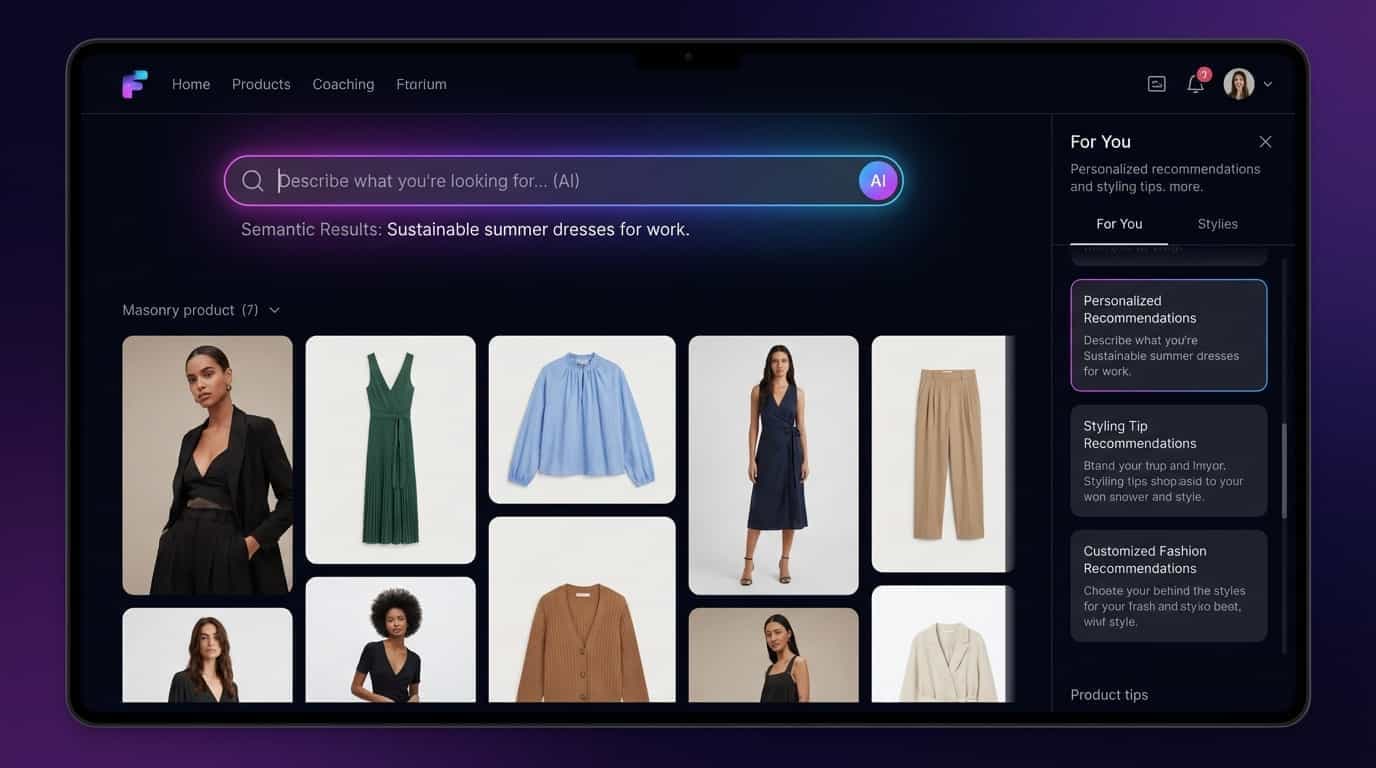
ShopSense had a search bar problem. Their customers knew what they wanted, but they didn't know how to describe it in ways that traditional keyword search understood. "Flowy summer dress for a garden party" returned zero results. "Dress" returned 3,000 results, none of them curated.
Their existing recommendation engine was equally frustrating — "You looked at a blue shirt, here are more blue shirts" isn't personalization, it's pattern matching. Customers wanted discovery: show me things I didn't know I wanted but would love.
The bigger problem: ShopSense was a 50-person company. They couldn't afford a team of ML engineers to build and maintain a custom recommendation system, and off-the-shelf solutions weren't delivering the experience their brand demanded.
Our Approach
We saw an opportunity to leverage recent advances in open source language models to build something genuinely different. Rather than relying on keyword matching or collaborative filtering, we built a system that actually understands what customers mean.
The core insight: treat product discovery as a conversation. When someone searches for "something for a beach wedding," they're expressing intent, style preferences, and context. A modern LLM can parse that — the challenge is connecting it to a product catalog efficiently.
Key Decisions
RAG Architecture with Local Models
We built a Retrieval-Augmented Generation system using locally-hosted embedding models. Product descriptions are vectorized and stored in a purpose-built index. Natural language queries are embedded and matched semantically — not by keywords.
Hybrid Search Strategy
Pure semantic search misses exact matches. We combine vector similarity search with traditional full-text search, weighted dynamically based on query characteristics. "Blue Nike Air Max size 10" triggers exact matching. "Something comfortable for standing all day" triggers semantic search.
Real-time Personalization Layer
We track browsing patterns in a real-time feature store, building a profile of style preferences, price sensitivity, and size patterns. These signals boost or demote results, creating a subtly personalized experience that gets smarter over time.
Self-Hosted for Cost Control
Cloud AI APIs charge per query. For an e-commerce site with millions of searches per month, that adds up fast. We deployed open source models on dedicated GPU infrastructure, giving ShopSense predictable costs and unlimited queries.
The Solution
The customer-facing experience is deceptively simple: a search bar that just works. Behind that simplicity is a sophisticated pipeline.
When a customer types a query, we:
- Classify the query intent (exact product, category browse, style exploration)
- Generate embeddings using a fine-tuned sentence transformer
- Query both the vector index and traditional search
- Blend and re-rank results using personalization signals
- Optionally generate AI-powered explanations ("This matches your search because...")
The recommendation engine uses similar technology, but inverted. Instead of matching a query to products, we match a customer profile to products, surfacing items they haven't seen but would likely love.
Tech Stack
- Sentence Transformers (Fine-tuned Embeddings)
- Qdrant (Vector Database)
- PostgreSQL (Product Catalog)
- Redis (Real-time Features)
- Next.js (Storefront)
- Python FastAPI (ML Services)
The Outcome
The impact was visible within days. Customers started using the search bar differently — longer, more natural queries that they'd never have tried before. "Outfit for meeting my boyfriend's parents" started returning thoughtful, styled suggestions.
The numbers validated the intuition: 34% lift in conversion from AI-powered recommendations, 2.3x increase in average order value, and 45% of searches now result in a purchase (up from 18% with the old system).
But the real win is harder to quantify. ShopSense's brand is built on curation and taste. The old search experience felt like a generic e-commerce template. The new experience feels like having a knowledgeable personal shopper — one who remembers what you like and surfaces things you didn't know you were looking for.
ShopSense has since expanded the system to power their email recommendations and homepage personalization. The same underlying models, different applications. They're now exploring conversational shopping — a chat interface where customers can refine their preferences in dialogue.