The Challenge
LogiFlow operates a fleet of 200 delivery vehicles across three metropolitan areas. Their dispatchers were planning routes manually, using a combination of experience, intuition, and a basic mapping tool that didn't account for real-world complexity.
The results were predictable: drivers getting stuck in traffic, missed delivery windows, frustrated customers, and fuel costs eating into razor-thin margins. They tried two off-the-shelf route optimization tools, but both assumed static conditions — they couldn't adapt to the reality of a city where traffic patterns change by the hour.
The deeper problem was data. LogiFlow had years of delivery records, GPS traces, and customer feedback locked in silos. They knew this data could make them smarter, but they didn't have the ML expertise to unlock it.
Our Approach
We approached this as a prediction problem first, optimization problem second. Before we could optimize routes, we needed to accurately predict three things: how long each delivery would take, what traffic conditions would look like at specific times, and which external factors (weather, events, road work) would cause delays.
Once we could predict, we could optimize. And importantly, we could re-optimize throughout the day as conditions changed.
Key Decisions
Predictive Models for Delivery Time
We built a gradient-boosted model that predicts delivery duration based on historical data: location, package type, time of day, weather, and dozens of other features. The model learns nuances like "this apartment building has a slow elevator" and "this business requires a signature from a specific person."
Real-time Traffic Integration
Static traffic data isn't enough. We integrated with live traffic APIs and built a model that predicts traffic conditions 2-4 hours into the future. The system knows that traffic on a specific highway gets bad at 3:15pm when a nearby factory ends its shift.
Continuous Re-optimization
Routes aren't static. When a driver finishes early, the system automatically re-sequences remaining stops. When traffic spikes unexpectedly, it reroutes in real-time. The mobile app pushes updates seamlessly — drivers just follow the next instruction.
Driver-Friendly Mobile Experience
The best algorithm is worthless if drivers don't use it. We built a clean, focused mobile app that shows one thing: where to go next. No cognitive load, no complex maps. Drivers love it because it makes their job easier.
The Solution
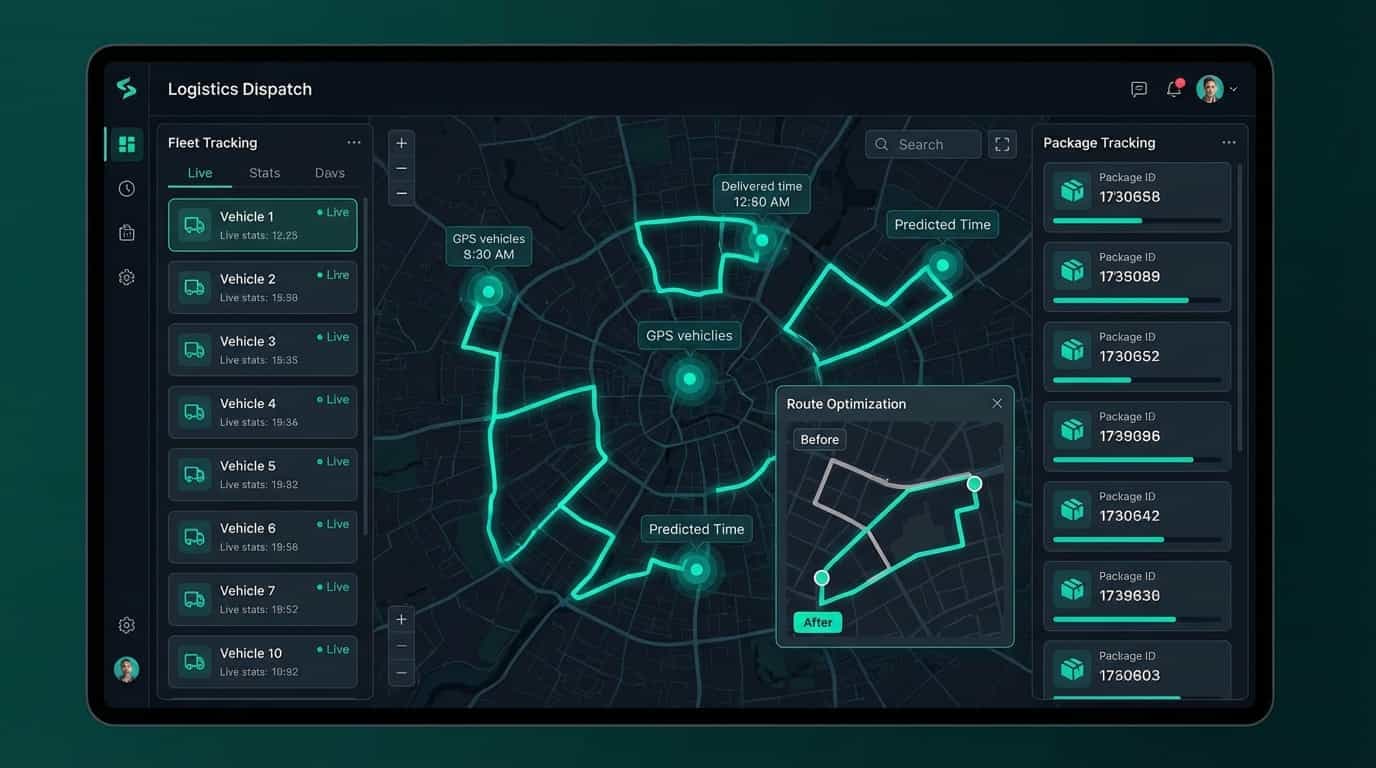
The system operates on two time horizons. Overnight, the planning engine processes the next day's deliveries, building initial routes that optimize for total efficiency while respecting time windows and vehicle capacity. In the morning, dispatchers review and approve — but increasingly, they just click "go."
Throughout the day, the real-time engine monitors progress. It tracks each vehicle's location, compares actual vs. predicted timing, and adjusts future stops accordingly. If a driver runs 15 minutes behind, the system might swap two stops to ensure a critical time window is still met.
The dispatch dashboard provides visibility without requiring action. Managers see fleet-wide status at a glance: which drivers are on track, which are at risk, and what the system is doing about it. Exceptions that require human judgment are surfaced prominently.
Tech Stack
- XGBoost (Predictive Models)
- Google OR-Tools (Optimization Engine)
- Python FastAPI (Backend Services)
- React Native (Driver Mobile App)
- PostgreSQL with PostGIS
- Redis (Real-time State)
- Kafka (Event Streaming)
The Outcome
The transformation was dramatic. Within the first month, on-time delivery jumped from 78% to 94%. After three months of model refinement with live data, it hit 97% — a number LogiFlow's dispatchers said was impossible.
The efficiency gains compounded. With better routing, drivers completed an average of 31% more deliveries per day. Fuel costs dropped 23% due to reduced mileage and less time idling in traffic. The planning team, which used to spend 4+ hours each morning building routes, now spends 20 minutes reviewing what the system suggests.
But the biggest impact was on driver satisfaction. The old system felt adversarial — routes that didn't make sense, time windows that couldn't be met, constant replanning. The new system feels supportive. Drivers trust it because it consistently makes their day smoother.
LogiFlow is now expanding to two additional regions. Each new market trains its own predictive models on local data, but the architecture scales cleanly. They're exploring using the same technology for dynamic pricing and demand forecasting.